

 Horowhenua Star
A bird gracefully swooping over a lake was an image Ōhau sculptor Bill Inge couldn’t resist.
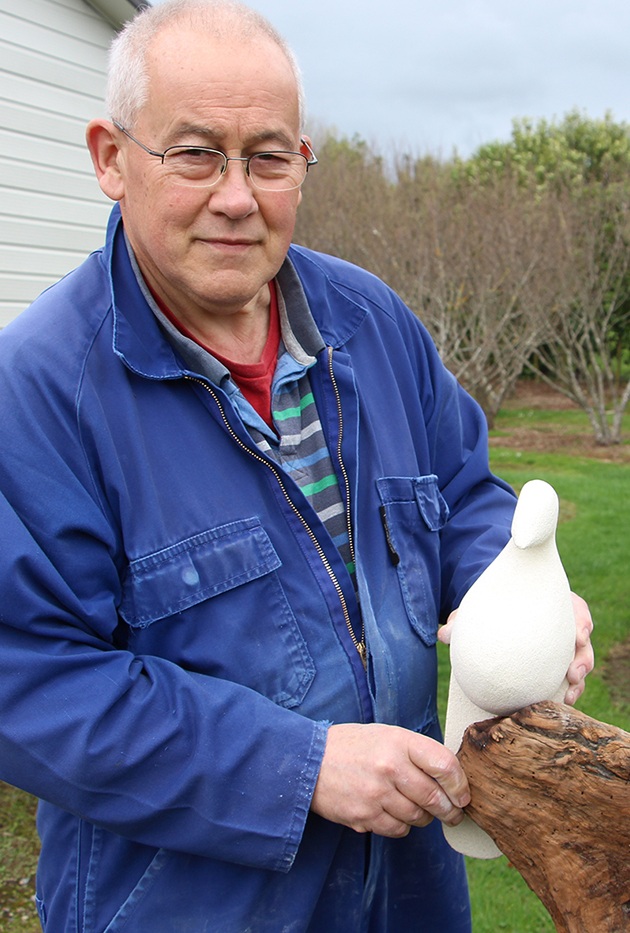
He had completed a weekend course in sculpting, a birthday present from his wife, and this image gave him an idea for a range of sculptures he is still working on years later: birds perched on a piece of a very large piece of driftwood.
This year Bill is part of Art Trail Manawatū for the first time, and the southern-most participant. Trail participants will be able to see his sculptures and chat to Bill at his Western Rise, Ōhau, home/workshop.
Sometimes he irreverently calls some of his creations “birds on a stick”, but they have struck a chord with many, and he often works on commission. His sculptures are in gardens throughout the country, but some end up inside people’s homes.
Seven years ago he and wife Jane, a furniture maker, moved to Ōhau from Raumati. Since he retired from work at Porirua City Council last year he has been sculpting full-time.
Every month he searches Horowhenua and Kāpiti beaches for suitable driftwood pieces.
“Finding suitable wood is the hardest part of this job,” he says. “I want my sculptures to last 10 years and there’s a fine line between good and rotten wood.”
He water-blasts the pieces once he gets them home.
“They need to be hardwood and heavy. The weight can tell you how solid it is.”
He says the reason wood on beaches is so light coloured is because the sun bleaches it.
“I’d prefer my wood to have a chocolatey colour.”
Once the wood is dry he treats it with Dryden wood oil to achieve his desired colour. He also burns off any loose bits. The drying process can take up to a month.
He says he leaves it to clients to decide how big a piece of driftwood they want for their sculpture, then how big a bird they want on it and how many. Some of his sculptures have multiple birds in different sizes, like assembling a family group or a couple.
“The second hardest thing in sculpting is coming up with names for my sculptures,” Bill says.
Lucky for him most clients have their own ideas about that.
Each piece of driftwood is anchored to the ground with a steel pipe, and if necessary, he will install the sculpture for a customer.
He works a lot outside. Oamaru stone produces a lot of dust, and while he works he is surrounded by 300 hazelnut trees that came with the property when he and Jane bought it.
Every February or March it’s hazelnut harvest time.
“We sold 350 kilograms last year. Eastern European and Chinese people love hazelnuts.”
The couple have a recipe book handy for their customers, too.
During the weekend Art Trail Manawatū is on he will provide demonstrations, and for those who are keen can have a go at sculpting the stone.
Oamaru stone comes in various kinds of hardness, and sculptures require a different type of stone than what’s used for buildings.
“Oamaru stone is made under water in the sea and that means worms, shells and other sea life can end up in the stone, sometime right in the middle, making the block useless, because of those sand holes,” Bill says.
Some pieces take two and a half hours, others more than four to sculpt into the shape he wants.
“You never know how tough or easy the job will be.”
Art Trail Manawatū runs on the weekend of October 18 and 19 between 10am and 4pm each day.
A digital trail guide, which has details of each participating artist and gallery, including locations, is available online at: communityarts.org.nz
OTHER STORIES