
 Horowhenua Star
School lunches have been in the spotlight again recently, raising issues around timing, nutritional value, and quality. Senior reporter JANINE BAALBERGEN looks at how our schools are coping.
Changes to funding for school lunches has been hard for all schools, but those in Horowhenua are managing by “doing it themselves”.
The government used to provide $8 per lunch for secondary students and $5 each for primary students. Now only $4 is available for each lunch box.

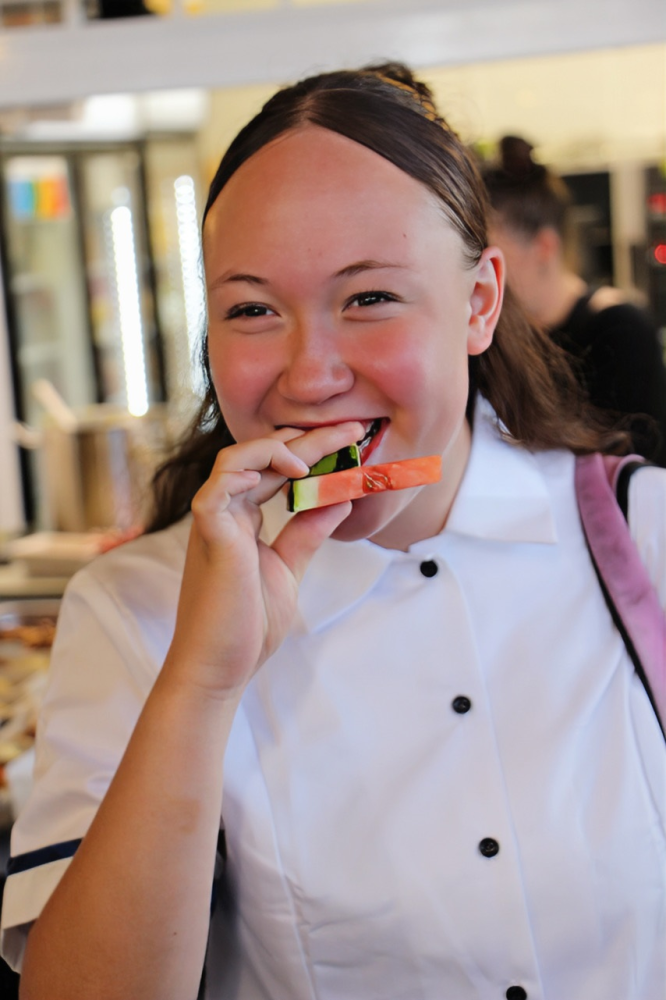
Manawatū College student Rleyah Hill enjoys a piece of watermelon at lunch time.
Photo Janine Baalbergen
It’s meant associated jobs at schools, caterers and suppliers have gone, and no local produce is used. Companies that supplied lunches have folded, and the job has been mainly outsourced to big global companies.
Horowhenua schools have met the challenge head-on, using their own resources to ensure their students remain well fed. All local secondary schools now make their own lunches, using local produce and employing local staff. Two also cater for primary schools.
Horowhenua College pulled out of its arrangement with national food supplier Libelle in July 2023. It has turned a cafe space at the college into a commercial kitchen, bringing the service in-house.
The college now has 13 women working in the kitchen preparing meals not only for their own students, but also for those at Levin North and Levin East primary schools.
Students from each whānau class come to the kitchen and collect their meals.
Meals are distributed during the first break at 10.45am to ensure students learn on a full stomach. They start with a karakia and eat together as a class.
Kitchen manager Anja Wagner, who has been a chef and cafe owner, says Ministry of Education guidelines are followed, but the college has its own menus, which vary each week. Student wishes are considered, but sometimes those wishes are too expensive.
“Chicken burgers, for example,” Anja says. “The buns alone add $400 to the cost each day, so we don’t do them too often.”
The college kitchen prepares 1000 meals every weekday for the college and 700 for the two primary schools. There’s nothing left over.
On the day the Star visited, it was nachos for the high school students and butter chicken for the primary school kids.
The free school lunch programme – Ka Ora, Ka Ako – was launched in 2019 for primary schools; 2020 for secondary schools. The recent cost-cutting changes were driven by Act leader David Seymour.
“I’d love to discuss the funding models with David Seymour,” college principal Grant Congdon says. “It’s quite possible to have a nutritious meal for not too much money.”
Waiopehu College makes lunches for its own 500+ students, and has done so since the free school lunches programme was introduced.
“This year the funding was cut in half, so we’ve had to reduce staff from eight to three,” says the school’s business manager, Carol Shore.
It means staff and senior students help hand out the meals.
“Previously we also made breakfast and morning teas,” she says.
With a funding drop to $4 per meal there’s not much room to manoeuvre. It’s also meant Carol has to do all the reporting to the Ministry of Education regarding the lunches. Previously the school paid someone to do that.
When the Star visited the kai team of three – Wai Gripp, Shannon Perry and Laura Lowery – were hard at work. They had prepared a wrap, muffins made by students from leftover bananas, a yoghurt, and a packet of popcorn. The menu board for the rest of the week showed there was a ham roll, meatballs and pasta, and a chicken sandwich. There’s always fresh fruit as well.
Any leftovers at Waiopehu go in the freezer so hungry kids can have a snack the next morning – the college serves lunch at 1.20pm.
Manawatū College principal Matt Fraser says his school is “continuing with our internal lunch delivery”, made onsite by a lunch team. It also caters for Coley Street and Foxton Beach schools.
“This is working very well for us, despite the funding cut,” Matt says.
The college used the government-suggested provider initially, but after a year and a quarter decided to go out on their own. It meant upgrading the school canteen and buying equipment. The kitchen is small and the funding is tight, but the team is making it work.
“I wish we’d done it from the start,” Matt says.
When the Star visited they were served mashed potato and gravy, with sausages, peas and carrots. For the rest of the week there were meatballs, muesli bars, yoghurt, meatball subs, beef-and-veg lasagna and oven-baked fish.
From last year lunches for two local primary school have been included, meaning every weekday 700-800 lunches are prepared.
The school has a fruit platter available through the day and there’s cold water on offer.
Lunches are made by local people, providing four jobs. It’s served at 11am, and any leftovers can be “seconds” for anyone who wants them.
OTHER STORIES
... loading ...